
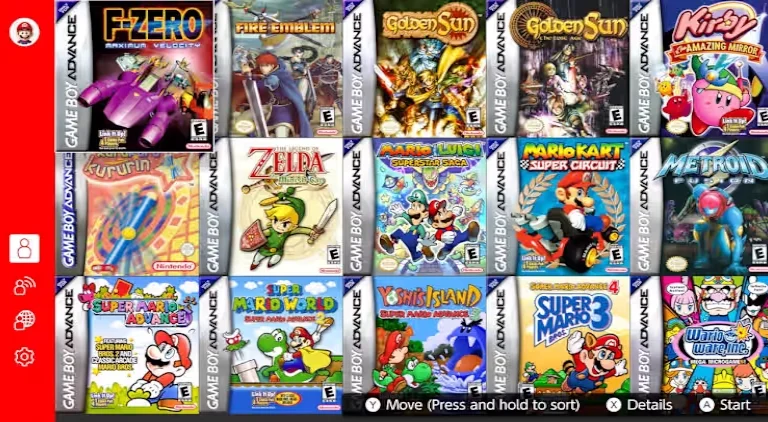
If you just picked up a retro handheld, launched the GBA app on your Nintendo Switch, or dug an old SP out of a closet, you are looking for the games that are actually worth your time today. Released in 2001, the Game Boy Advance arrived right as home consoles abandoned 2D sprites in favor of early 3D polygons. That shift made the handheld a haven for developers who had mastered pixel art and wanted to push 16-bit and 32-bit mechanics to their absolute limit.
The GBA functioned like a supercharged portable Super Nintendo. It offered responsive inputs, instant load times, and hardware capable of running complex physics engines, pseudo-3D scaling, and massive sprite animations. More importantly, it bridged classic design sensibilities with modern convenience by standardizing responsive save systems and streamlined interfaces.
This list cuts straight through the nostalgia. The games below are not here simply because they were popular during school recess in 2003—they earn their spot because their mechanics, visual presentation, and pacing hold up against modern indie and commercial releases today.
The Essential RPGs
Pokémon Emerald and FireRed/LeafGreen
Generation 3 established the mechanical foundation of the modern Pokémon franchise. Pokémon Emerald remains the definitive Hoenn adventure, refining the dual-storyline conflict between Team Magma and Team Aqua while introducing the Battle Frontier—an endgame challenge unmatched in later entries. Meanwhile, FireRed and LeafGreen rebuilt the original Kanto journey with vibrant sprite art, quality-of-life menu overhauls, and the expansive Sevii Islands post-game. Their snappy movement, clean color palettes, and rock-solid turn-based design make these titles endlessly replayable.
Golden Sun and Golden Sun: The Lost Age
Developed by Camelot, Golden Sun and its direct continuation, The Lost Age, are technical marvels that form a single epic story across two cartridges. The games feature dynamic, pseudo-3D battle sequences with rotating cameras, screen-filling summon animations, and a rich soundtrack pushed through the GBA sound chip. Outside of combat, the series stands apart by letting players cast “Psynergy” spells in the overworld to solve environmental puzzles, move obstacles, and reveal hidden passages. The collectible Djinn system adds deep customization, allowing you to swap elemental spirits to alter character classes and stats on the fly.
Mother 3
Though never officially localized outside Japan, Mother 3 stands as one of the most poignant, emotionally mature role-playing games ever produced. Written by Shigesato Itoi, the game shifts from whimsical absurdism to devastating family tragedy across eight distinct chapters. In combat, Mother 3 introduces a rhythm-action combo mechanic where players tap the attack button in time with the background music’s bassline to land up to 16 consecutive hits. Its expressive animations, sharp social commentary, and heartbreaking musical motifs make it an indispensable masterpiece.
Top Action and Metroidvania Games
Metroid Fusion and Metroid: Zero Mission
The GBA gave birth to two of the finest 2D side-scrollers in history. Metroid Fusion took a narrative-heavy, suspenseful approach, trapping Samus Aran on a research station hunted by the SA-X—an invulnerable mimic of her fully powered self. It delivers terrifying tension, tight corridor navigation, and responsive ledge-grabbing mechanics. In contrast, Metroid: Zero Mission remakes the original 1986 NES game into an agile speedrunner’s playground. Its fluid wall-jumping, sequence-breaking potential, and snappy weapon handling set the gold standard for 2D movement.
Castlevania: Aria of Sorrow
Following two earlier GBA entries that struggled with screen brightness and muddy controls, Konami perfected portable gothic action with Castlevania: Aria of Sorrow. Set in the near future inside Dracula’s solar eclipse-bound castle, you play as Soma Cruz, a protagonist equipped with the “Tactical Soul” system. Nearly every enemy in the game can drop its soul upon defeat, granting you unique offensive attacks, stat boosts, or movement abilities. The sheer variety of soul combinations, combined with silky-smooth sword swings and atmospheric pixel art, places it right alongside Symphony of the Night at the top of the franchise.
The Legend of Zelda: The Minish Cap
Developed by Capcom’s Flagship studio, The Legend of Zelda: The Minish Cap is arguably the most visually striking 2D Zelda game ever made. The core mechanic revolves around Ezlo, a magical talking cap that lets Link shrink to the size of an acorn. Shrinking radically transforms familiar environments: a simple puddle becomes a massive lake, and a standard Green Chuchu turns into an imposing dungeon boss. With clever item integration (like the Gust Jar and Cane of Pacci) and lively character animations, it delivers dense, inventive dungeon design from start to finish.
Turn-Based Strategy Games
Advance Wars and Advance Wars 2: Black Hole Rising
Intelligent Systems struck gold with the Advance Wars series, stripping away the clutter of traditional war games to deliver pure tactical strategy. You command military forces—infantry, tanks, battleships, and bombers—on a clean grid, capturing cities to fund unit production while managing fog of war and supply lines. The asymmetric Commanding Officer (CO) powers add dramatic swings in momentum, giving you distinct tactical archetypes to master across dozens of challenging campaign maps and standalone War Room puzzles.
Fire Emblem (The Blazing Blade)
The first entry in the long-running franchise to reach Western audiences, Fire Emblem established the formula that captivated strategy fans worldwide. Featuring three interwoven campaigns centered on Lyn, Eliwood, and Hector, the game forces you to weigh every tactical move against the looming threat of permanent character death. Every unit is a distinct character with unique support conversations, making battlefield losses sting on an emotional level. The hand-drawn critical hit combat animations remain some of the most dynamic 2D battle sprites ever drawn.
Final Fantasy Tactics Advance
Transporting a group of schoolchildren into the fantasy world of Ivalice, Final Fantasy Tactics Advance offers an accessible yet deeply layered strategy RPG. It features an isometric grid, dozens of unique fantasy jobs (from Paladins and Time Mages to Viera Assassins), and a controversial “Judge” system that enforces shifting rules on the battlefield—such as banning fire magic or ranged weapons. Building custom squads and optimizing skill combinations across races and classes provides dozens of hours of deep tactical experimentation.
GBA Hidden Gems Worth Seeking Out
- Drill Dozer: A creative action-platformer by Game Freak where you pilot a customizable bipedal mech equipped with a multi-gear drill. The original cartridge included a built-in rumble motor, providing physical tactile feedback as you drilled through concrete walls, switched gears to build torque, and deflected enemy projectiles.
- Astro Boy: Omega Factor: Developed by action legends Treasure and Hitmaker, this side-scrolling beat-’em-up features breathtaking sprite scaling, screen-clearing laser blasts, and frantic melee combat that tests your reflexes at every turn. It serves as an affectionate celebration of Osamu Tezuka’s entire body of work.
- WarioWare, Inc.: Mega Microgame$!: Long before mobile touchscreens popularized bite-sized gaming, this title pioneered five-second “microgames.” It throws rapid-fire, absurd visual challenges at the player with zero downtime, demanding quick reflexes and comedic adaptability.
Experience the GBA Library on Modern Hardware
You have several great ways to play these classics today, depending on whether you value official convenience, original hardware, or modern screen technology:
- Nintendo Switch Online + Expansion Pack: The most accessible legal path. Nintendo’s official app features a growing, curated library including The Minish Cap, Metroid Fusion, Fire Emblem, and Golden Sun, complete with crisp display filters, save states, and online multiplayer.
- FPGA Hardware (The Analogue Pocket): For hardware purists, the Analogue Pocket uses field-programmable gate arrays to recreate original GBA hardware at the transistor level. It accepts original cartridges directly and runs them on a gorgeous, pixel-dense display that replicates original LCD sub-pixels without emulation lag.
- Dedicated Emulation Handhelds: Modern Linux- and Android-based pocket consoles (such as devices from Miyoo, Anbernic, or Retroid) feature high-quality 3:2 and 4:3 IPS/OLED screens that scale GBA games with integer perfection, offering physical controls and long battery life for players building a portable retro archive.
- Flash Carts on Original Hardware: If you prefer holding an authentic GBA SP (AGS-101) or an original model with an aftermarket IPS screen, a modern flash cart like the EverDrive-GBA X5 allows you to run backup ROMs directly on real Nintendo silicon.
I have a Gameboy Advance Sp ags 101 that has a backlit screen I bought it originally from the early 2000s It still works its my favorite handheld and I love it I play a lot on it!?
It depends on what hardware you have. If you have a Gameboy Advance/DS (Original)/DS Lite, you would be best off getting a Gameboy flashcart. Unfortunately, I’m not very familiar with these. If you have a DSi, your only option is to buy a DS-mode flash card like the aforementioned DSTWO, due to the lack of a Gameboy cartridge slot. If you have a 3DS, extra hardware may not even be necessary. On all current firmwares, you can use the tubehax exploit to gain access to the homebrew launcher. There are a few gameboy advance emulators available for the homebrew launcher, and while last I checked they weren’t perfect, they’re the best you can currently get.